
FY22 will be the year to rebuild with the IMF projecting output growth at 11.5 per cent, economic survey at 11.0 per cent and the RBI's Monetary Policy Committee at 10.5 per cent.

In the current fiscal so far, retail inflation stabilised around 5 per cent, while wholesale price-based inflation averaged around 2.9 per cent during April-December.

This is the 14th consecutive month that the manufacturing PMI remained above the 50-point mark. In PMI parlance, a print above 50 means expansion, while a score below that denotes contraction.

Urjit Patel's reappointment will raise market hopes that Rajan, will also be offered an extension when his tenure ends in September.

investors will look to the new governor to continue the banking sector clean-up with the same urgency as Mr Rajan, who was targeting fully cleaned-up and provisioned balance sheets by March 2017

Slowdown in industrial production notwithstanding, a marginal increase in inflation raised the clamour for another round of rate cut by the Reserve Bank on April 4 to boost economic activity.

'If rate cuts happen, bond yields will come down and investors will make mark-to-market capital gains on them.'

Stressed MSME borrowers would be eligible for restructuring of debt, if their accounts were classified standard.

The government hopes the latest action will lead to banks also lowering the cost of borrowing for corporate and individual borrowers.

The career bureaucrat-turned-central banker walked into the 19th floor corner room of the Reserve Bank on December 12, 2018. Since February 2019, the Das-led RBI has cut the repo rate by a whopping 135 basis points to support the sagging growth, including an unprecedented 35 bps reduction in August. As he completes one year at the helm, woes in the NBFC sector, overall health of the banking sector and steeply falling economic growth are among the major challenges that needs to be tackled sooner than later.

India's services sector growth eased to a three-month low in June but service providers continued to signal positive demand trends, which resulted in a stronger increase in new business volumes and further job creation, a monthly survey said on Wednesday. The seasonally adjusted S&P Global India Services PMI Business Activity Index fell from 61.2 in May to 58.5 in June. Despite falling from May, the latest figure was consistent with a sharp pace of growth.
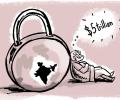
Chief Economic Advisor V Anantha Nageswaran on Thursday expressed hope that the economy will maintain the trend growth rate of 6.5 per cent and above for the rest of the years in the current decade. The economy will close the current fiscal logging in a growth of 6.5-7 per cent, he said, citing the projections of private sector analysts, Reserve Bank of India (RBI) and international agencies like OECD and the IMF. "This appears to be reasonable at this point in time although we will get the data on the fiscal second quarter in a few days, which will give more clarity on these numbers.

India's macroeconomic situation is improving fast and the country's GDP growth will turn positive in the third and fourth quarters of the current financial year, eminent economist Ashima Goyal said on Sunday. Goyal in an interview to PTI said the management of the COVID-19 pandemic and gradual unlocks announced by the government have helped in avoiding multiple COVID-19 peaks. The growth estimates by different agencies are being continuously revised, she said.

The resignation is sure to create more political firestorms for the government as it comes on the eve of the winter session of Parliament where the Opposition has already made it clear to the treasury benches that infringing on the RBI autonomy would be a big talking point for them.

The Indian services sector activity fell to a six-month low in September, as new business inflows rose at the slowest rates since March, amid inflationary pressures and competitive conditions, a monthly survey said. The seasonally adjusted S&P Global India Services PMI Business Activity Index fell to 54.3 in September, from 57.2 in August, highlighting the weakest rate of expansion since March. For the fourteenth straight month, the services sector witnessed an expansion in output. In Purchasing Managers' Index (PMI) parlance, a print above 50 means expansion, while a score below 50 denotes contraction.
Probably in August. We can argue whether RBI is dovishly neutral or neutrally dovish but the telltale signs of at least one more rate cut are strewn all over the policy statement, points out Tamal Bandyopadhyay.

The rupee plunged 58 paise to close at an all-time low of 81.67 (provisional) against the US dollar on Monday as the strengthening of the American currency overseas and risk-averse sentiment among investors weighed on the local unit. Moreover, escalation of geopolitical risks due to conflict in Ukraine, a negative trend in domestic equities and significant foreign fund outflows sapped investor appetite, forex traders said. At the interbank foreign exchange market, the local currency opened at 81.47, then fell further to close at an all-time low of 81.67 against the American currency, registering a decline of 58 paise over its previous close.

RBI may revise remuneration for banks.

The recovery in the Indian services sector was sustained in November as new work orders supported business activity growth and the first rise in employment in nine months, a monthly survey said on Thursday.
The industrial output for the third month in a row remained in the negative territory, contracting 1.5% in January

There is so much liquidity in the system, in the global economy, and that's why the stock market is very buoyant. It will certainly witness correction in the future: RBI's Das.
Priorities include the amendments of the Companies Act and the Motor Vehicle Act

Progress on monsoons along with favourable base effect in 2HFY2017 continues to point towards RBI achieving its near 5 per cent inflation target by the year-end

RBI Governor Raghuram Rajan, who today surprised markets with a rate hike, defended the move saying a rate cut would not have impacted either banks or borrowers and that bringing down retail prices is the key to sustainable growth.
India's services sector output growth touched a three-month high in November as business inflows rose markedly amid accommodative demand conditions, a monthly survey said on Monday. The seasonally adjusted S&P Global India Services PMI Business Activity Index rose from 55.1 in October to 56.4 in November, indicating a sharp increase in output that was the quickest in three months even amid higher operating expenses. Survey participants linked the latest expansion to demand strength, successful marketing and a sustained upturn in sales.
RBI in wait and watch mode as several risks to inflation continue to exist including a sudden reversal of food prices and oil price volatility.

However, growth is expected to bounce back to an average of 7.3 per cent in the second half of 2017 and 7.7 per cent in 2018

A two-year extension at the helm of the RBI still looks a real possibility

The government's total liabilities rose to Rs 128.41 lakh crore in December quarter from Rs 125.71 lakh crore in the three months ended September 2021, according to the latest public debt management report. The increase reflects a quarter-on-quarter increase of 2.15 per cent in October-December 2021-22. In absolute terms, the total liabilities, including liabilities under the 'Public Account' of the government, jumped to Rs 1,28,41,996 crore at the end of December 2021.

A rise in petrol and diesel consumption can help the government cut cesses on the fuels by Rs 4.5 a litre without impacting revenue collections of FY21, and help cool off the pressure on inflation, domestic rating agency ICRA said on Friday. Petrol consumption is estimated to increase 14 per cent in 2021-22 and diesel by 10 per cent on the lower base, rise in mobility and economic recovery, ICRA said. The rating agency added that it will result in an additional Rs 40,000 crore in revenue for the government through higher collections of the cess.

However, it may still not change its stance on the policy rate as inflationary pressures are coming from high commodity prices.
The discussion paper is released at a time when the central bank is sifting through 26 applications seeking an entry into the fray.

Arguing that the recent elevation in retail inflation is not structural but supply-driven and therefore potentially transitory, a foreign brokerage report has forecast that the benign interest rate regime will continue at least until next June. The assessment comes a day ahead of the third bimonthly monetary policy review on Friday wherein it's widely expected that the monetary authority will leave the key rates unchanged at 4 per cent even though the consumer prices have been on remaining above 6 per cent since May and crude prices have been north of $70 a barrel for months.

His finest years came when he served as deputy governor under C Rangarajan.

As per the RBI Act, the central bank has to have four deputy governors.

Domestic macroeconomic data, RBI policy and developments related to the Russia-Ukraine war would be major driving factors for the stock market this week, analysts said. Moreover, FPI investment and trends in crude oil would also influence the trading sentiment, they added. "This week, the RBI credit policy will be a critical factor for Indian markets.

The rate of price rise in the vegetable segment almost doubled to 7.47 per cent as against 3.92 per cent in September.
The Reserve Bank on Monday pitched for creation of a conducive environment for investment and faster clearances of projects to boost economic growth which slowed to a decade low of 5 per cent in the previous fiscal.

The broader NSE Nifty closed 1.25 points, or 0.01 per cent down at 10,564.05.

The former RBI deputy governor talked about the prospects of an economic revival, reforms in IMF, etc.
